
School Blog 11
Good day friends and foes, and welcome to this weeks addition of team JSBP’s excursion review. Last Wednesday was an interesting one for my homies and I. We finally got a chance to visit the Great Synagogue of Budapest, which is an enormous and beautiful building that we’ve been walking past almost everyday of the semester. The Jewish population has experienced major hardship in recent history here, and much of their struggle with racism and persecution was directly felt in and around this place of worship.
 |
| The Great Synagogue, a police officer patrols the front entrance 24 hours a day, 7 days a week |
The Great Synagogue of Budapest (a city once labeled ‘Judapest’ by intolerant Magyars and Germans because of its large and thriving Jewish population) is the second largest in the world, and the largest place of Judaic reverence in Europe. During the industrial revolution of Hungary much of the Jewish population in Budapest started factories, and many smart Jewish entrepreneurs capitalized on the mechanization of manufacturing. The Jewish faith and the progression of urbanization became synonymous ideas to much of the feudal and agricultural population of Magyars, especially those who lived outside of the city. There was a strong resentment felt by many Hungarians who had resisted change and been left behind by technology and capitalism towards the Jews of their country.
In the 1920s, Hungary passed some of the first anti-Jewish laws in Europe under their anti-Semitic leader regent Miklos Horthy. In the 1940s, when Nazi Fascism was spreading like wildfire through the continent, Hungary joined the cause and publically implicated Jews as being an inferior race that had caused much of their nation’s hardship.
| Horthy with Hitler |
Throughout World War Two the Jewish population of Budapest was forced to suffer the horrifying tragedies of the holocaust. In the city the Nazis appointed the Arrow Cross (the Hungarian Fascist party) to run their operations. The Jewish quarter of the city was located behind the Great Synagogue. It was turned into a Jewish ghetto when the Arrow Cross took over, in which people endured dire living conditions. Starvation was not uncommon, and there was no escape from the freezing temperatures of Hungary’s harsh winter. By the time that the war had officially ended there were around 2,300 dead bodies lying in the streets of the once thriving Jewish quarter, many of which were buried in mass graves next to the synagogue. There are only estimates of how many Jews were shot into the Danube after being taken from their homes by the Arrow Cross officers.
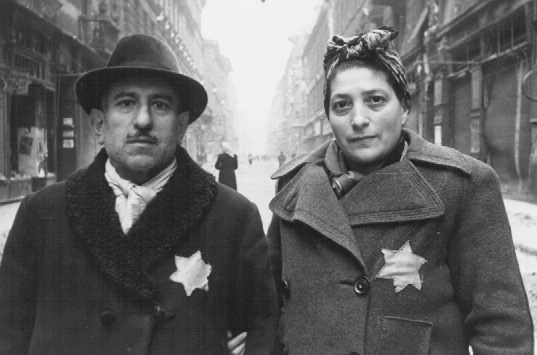 |
| Hungarian Jews in the Budapest Ghetto, wearing the yellow Star of David for Fascist identification purposes |
The only reason that the Great Synagogue still stands in the center of Budapest is because of its two massive towers. Due to the fact that the synagogue was constructed so well, and its towers rose up so high, the Nazis chose to use the building as a radio communications headquarter, rather than to destroy it. The survival of the beautiful building is hard to believe, but perhaps more hard to believe is the fact that many Hungarian Jews still live, work, and worship in the area after such horrible atrocities were committed upon them.
 |
| Packed House |
The numbers of how many Jews that were killed during the holocaust are absolutely staggering. The acts of terror that the Jewish people went through because of their ethnicity and beliefs are even more horrifying. But the beauty that has come out of such maniacal violence is that Judaism and the Jewish people are still here, even after what they and their ancestors have gone through. The man that had given us a tour of the magnificent symbol of Jewish endurance was a young Hungarian Jew himself. He still lives in the city where many of his relatives have been hated for no reason in the past, and yet he wore no anger in his expression, nor spoke a word of resentment. The sins of the holocaust did not destroy the Great Synagogue of Budapest, and did not wipe out its worshipers. I have a feeling that nothing ever could, and that both the synagogue and its people will still be in Budapest as long as time allows.

Tito, I like the historical overview that you gave in this post. From what I read, it seems like you talked about a lot of stuff from Agnes' class...we're actually learning something! Very impressive. Also, you mentioned it in passing, but how weird was it that we were actually in the Budapest ghetto, and that we've been in the Arrow Cross HQ...sometimes I can't get over how weird it is that these victims and perpetrators...part of a devastating history, stood in these places that we go to. hope you're having fun in praha!
ReplyDeleteTito! Really great blog, I especially enjoy your pictures this week.
ReplyDeleteI agree with Mary that you did a really great job writing the historical overview of the Great Synagogue and persecution of the Jewish population. It is awesome that we are learning from Agnes and Lazslo and that it's actually shining through!
It was also crazy for me that we were in the Budapest Ghetto. After seeing Aucshwitz Birkenau just a couple weeks ago, it is still shocking for me to see the pictures of the poor Jewish people. As you mentioned also, it is always mind boggling to me to understand how Jewish individuals like our tour guide can discuss what happened to the Jews and not show any resentment throughout the tour.
Job well done sir! Hope you're having so much fun in Praha! Happy thanksgiving!
Tito! I thought it was really cool that you used the knowledge we've gained from Agnes's class and applied it to what we learned at the synagogue. i agree it is a terribly sad history for the jewish population in Europe, especially in Budapest. Well done finding the picture of Hitler and Horthy acting chummy in together. This really drove home the point of how ruthless Horthy was, though he is not given much attention on a global level.
ReplyDelete